All-on-4 Dental Implants in Canada: Cost, Procedure, and Who Qualifies
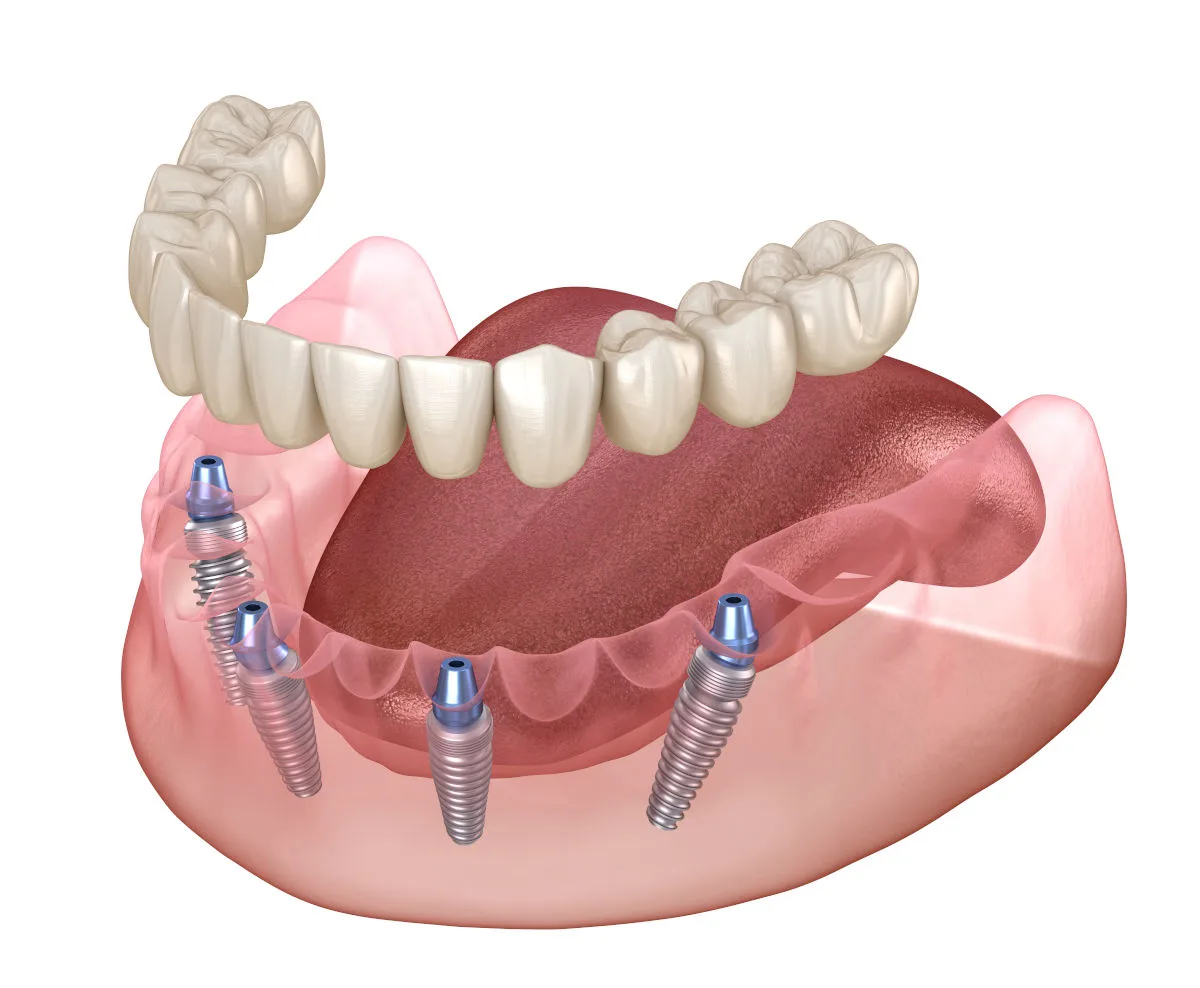
All-on-4 replaces an entire arch of teeth (upper or lower) with a fixed bridge supported by just four strategically placed implants, often delivering a full set of provisional teeth on the day of surgery. In Canada, expect to pay $20,000 to $30,000 per arch, with the total national range spanning roughly $15,000 to $35,000 depending on materials and preparatory work.
Here is everything the treatment involves, who it works for, what can go wrong, and how it compares to the alternatives.
What Is All-on-4?
The concept is in the name: all your teeth on four implants. Two implants are placed vertically at the front of the jaw, and two longer implants are placed at the back at an angle of up to 45 degrees. That tilt is the engineering insight that makes the technique work: angled posterior implants maximize contact with available bone, which means most patients avoid the bone grafting that traditional full-arch implant treatment would require.
Onto those four posts, your surgical team fixes a full arch of prosthetic teeth. Unlike a denture, the bridge does not come out, requires no adhesive, and is cleaned like natural teeth (with some technique adjustments).
Teeth in a Day: How the Procedure Actually Unfolds
1. Planning (1 to 3 weeks before surgery). A CBCT 3D scan maps your bone volume, sinus position, and nerve locations. Impressions and bite records let the lab prepare your provisional bridge before you ever sit in the surgical chair.
2. Surgery day (2 to 4 hours per arch). Under local anesthesia, usually with optional IV sedation, the surgeon removes any failing teeth, places the four implants, and attaches a temporary fixed bridge the same day. You walk in with failing teeth or dentures and walk out with fixed teeth.
3. Healing (3 to 6 months). The implants fuse with your bone. You eat a soft diet for the first weeks and progress gradually. The provisional bridge is deliberately lighter than the final one to protect the healing implants.
4. Final bridge. Once integration is confirmed, the provisional is replaced by your definitive bridge, typically in acrylic on a titanium frame or full zirconia.
All-on-4 Cost in Canada
| Component | Typical range (CAD) |
|---|---|
| All-on-4, one arch (surgery + provisional + final bridge) | $20,000 to $30,000 |
| Full mouth (both arches) | $40,000 to $60,000+ |
| Zirconia final bridge upgrade | $3,000 to $8,000 over acrylic |
| Extractions, sedation, imaging (if billed separately) | $1,000 to $4,000 |
Prices trend higher in Toronto and Vancouver and lower in smaller markets. Ontario quotes commonly land between $25,000 and $35,000 per arch, while some clinics advertise fixed packages starting around $23,000.
Three questions to ask any clinic quoting you:
- Does the price include extractions, sedation, the provisional bridge AND the final bridge?
- What material is the final bridge, and what does the zirconia upgrade cost?
- What is the warranty on the implants and on the prosthetic work?
Insurance rarely covers the full treatment, though portions (extractions, imaging) may be reimbursable, and the whole amount qualifies for the Medical Expense Tax Credit. Our Canadian implant cost guide covers financing and tax strategies in detail.
Who Is a Good Candidate?
All-on-4 was designed for people who are missing most or all teeth in an arch, or whose remaining teeth are failing. Good candidates typically:
- Have moderate bone loss (the angled implants tolerate less bone than traditional methods, which is the technique's core advantage)
- Are in good general health for a surgical procedure
- Do not smoke, or are willing to stop around surgery (smoking significantly raises implant failure risk)
- Have controlled diabetes if diabetic
- Are committed to hygiene and follow-up visits
Severe upper jaw bone loss may push the plan toward All-on-6 or zygomatic implants instead. Only a CBCT scan and clinical exam can confirm candidacy. Our Surrey implant page explains how that consultation works locally.
All-on-4 vs the Alternatives
vs conventional dentures. Dentures cost far less upfront ($1,000 to $3,000 per arch) but slip, limit diet, accelerate bone loss, and need periodic relining and replacement. All-on-4 is fixed, restores near-natural chewing force, and stimulates the bone, which preserves facial structure.
vs All-on-6. Six implants distribute force more widely and add redundancy. It costs more and requires more bone. Surgeons often recommend six in the upper jaw (softer bone) and four in the lower.
vs implant-retained overdentures. A snap-on denture on two to four implants costs $6,000 to $15,000 per arch. It is much more stable than a conventional denture but still removable. The right choice if All-on-4 exceeds your budget.
vs traditional full-arch implants (8 to 10 implants). The pre-All-on-4 standard. More implants, almost always bone grafting, longer treatment, higher cost. Still preferred in select cases. For single-tooth decisions rather than full arches, see our dental bridge vs implant comparison.
Recovery: What to Expect
- Days 1 to 3: swelling and manageable discomfort, comparable to other oral surgery. Cold compresses and rest.
- Weeks 1 to 2: soft food only (soups, eggs, yogurt, smoothies). Most patients return to desk work within 2 to 5 days.
- Weeks 2 to 8: progressive return to a normal diet, avoiding very hard or sticky foods.
- Months 3 to 6: final bridge placed. Full chewing function restored.
Risks and Downsides Nobody Should Hide From You
- Implant failure. Reported success rates for All-on-4 exceed 95 percent over 10 years, but if one of only four implants fails during healing, the bridge loses support and part of the treatment must be redone.
- Prosthetic maintenance. Acrylic bridges wear and can chip; expect maintenance or replacement of the prosthetic component over 10 to 15 years even when implants remain perfect.
- Speech adaptation. Days to a few weeks to adapt to the new palate contour.
- Hygiene demands. Cleaning under a fixed bridge requires water flossers or special brushes. Neglect leads to peri-implant inflammation, the main long-term threat to the treatment.
- Irreversibility. Remaining teeth in the arch are removed. This is the right call when those teeth are failing, and the wrong one when several could be saved. A second opinion is never wasted before a full-arch decision.
Before and After: Realistic Expectations
The transformation is real: patients replace failing teeth or loose dentures with a fixed, natural-looking smile in one day, and the effect on chewing, speech, and confidence is well documented. Temper two expectations. First, the provisional bridge worn during healing is a functional temporary, not the final aesthetic result. Second, the final smile design is decided with you (tooth shade, shape, gum line) before fabrication, so bring photos and opinions to that appointment.
Frequently Asked Questions
How much are All-on-4 dental implants in Canada? $20,000 to $30,000 per arch on average, within a national range of $15,000 to $35,000. Both arches typically cost $40,000 to $60,000.
What are the downsides of All-on-4? High upfront cost, prosthetic wear over 10 to 15 years, demanding hygiene under the bridge, adaptation time for speech, and dependence on all four implants integrating successfully.
How long do All-on-4 implants last? The implants themselves can last decades, with 10-year success rates above 95 percent. The bridge component typically needs maintenance or replacement after 10 to 15 years (acrylic) or longer (zirconia).
Can you eat anything with All-on-4? After full healing, nearly anything. Most surgeons advise ongoing caution with extremely hard items (ice, hard candy) to protect the prosthetic teeth, the same advice given for natural teeth.
Is All-on-4 painful? Surgery is done under local anesthesia with optional sedation. Post-operative discomfort peaks in the first 72 hours and is typically well controlled; most patients describe recovery as easier than expected given the scope of the procedure.
Am I too old for All-on-4? Age alone is not a barrier; patients in their 70s and 80s receive All-on-4 routinely. Overall health, bone volume, and healing capacity matter far more than the birth year.
All-on-4 or dentures: which is better? If budget allows and you qualify, All-on-4 outperforms dentures on stability, chewing power, bone preservation, and quality of life. Dentures remain the accessible option, and implant-retained overdentures sit usefully in between.
Surrey Dental Implants
Surrey Dental Implants is based in Surrey, British Columbia. See our dental implant services, or return to the dental implant resources hub for the rest of this series.