Types of Dental Implants: The Complete Canadian Guide
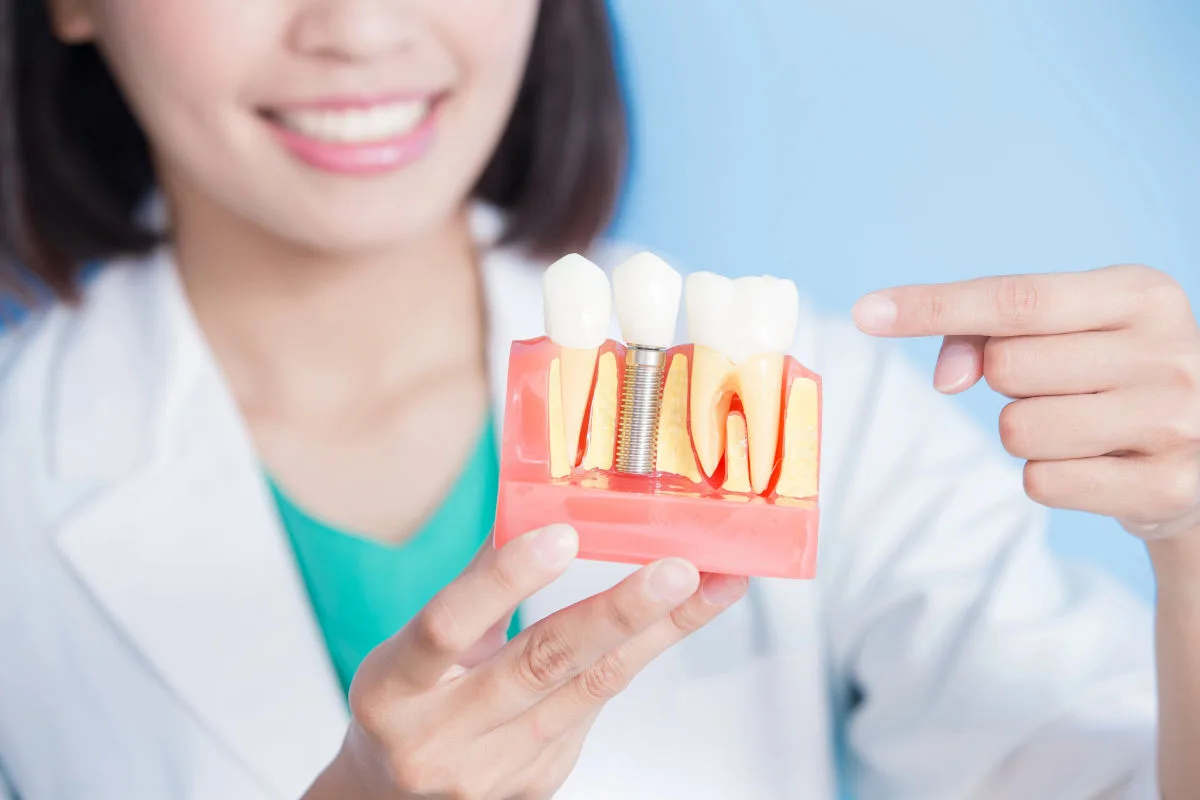
There are three surgical types of dental implants (endosteal, subperiosteal, and zygomatic), several restoration configurations built on top of them (single crowns, implant-supported bridges, All-on-4, implant-retained dentures), and two attachment methods (screw-retained and cement-retained). Choosing correctly determines how long your implant lasts, how it looks, and what you pay.
This guide covers every option available in Canada, what each costs, and who each one is designed for.
The Anatomy of Every Dental Implant
Whatever the type, every implant system has three parts:
- The implant body (post): the artificial root placed in or on the jawbone, almost always titanium because it is biocompatible and fuses with bone (osseointegration).
- The abutment: the connector between the post and the visible tooth.
- The restoration: the crown, bridge, or denture attached on top.
The "type" of implant refers to how and where the post is placed, and what restoration it carries.
The 3 Surgical Types of Dental Implants
1. Endosteal Implants (the standard)
Endosteal implants are placed directly into the jawbone, shaped like small screws or cylinders. They account for the vast majority of implants placed in Canada and are the option your dentist means by default when discussing "an implant."
- Best for: patients with adequate jawbone density and volume.
- Success rate: around 95 percent or higher over 10 years.
- Cost in Canada: $3,000 to $6,000 per complete tooth. See our full Canadian cost guide for provincial breakdowns.
- Timeline: three to eight months from placement to final crown, allowing for osseointegration.
2. Subperiosteal Implants (for insufficient bone)
Instead of entering the bone, a subperiosteal implant sits on top of the jawbone, under the gum tissue. A custom metal framework is fitted over the bone, and posts protruding through the gums support the replacement teeth.
- Best for: patients without enough healthy bone for endosteal implants who cannot or prefer not to undergo bone grafting.
- Trade-off: historically lower long-term success than endosteal implants; today used far less often because bone grafting and short/mini implants usually offer better outcomes.
- Cost: typically higher than endosteal due to the custom framework.
3. Zygomatic Implants (the specialist option)
Zygomatic implants are much longer posts anchored in the cheekbone (zygoma) rather than the upper jaw. They are reserved for severe upper jaw bone loss where even grafting cannot create enough support.
- Best for: extensive upper jaw bone resorption, often after years of denture wear.
- Who places them: oral and maxillofacial surgeons with specific zygomatic training; a small number of Canadian centres offer them.
- Cost: significantly higher than standard implants; full arch zygomatic cases commonly exceed $35,000.
Mini Dental Implants
Mini implants are narrower versions of endosteal implants (under 3 mm in diameter versus 3.5 to 6 mm for standard posts). They are placed with a less invasive technique, often without incisions, and can sometimes be loaded the same day.
- Best for: stabilizing lower dentures, replacing small teeth (such as lower incisors), and patients with narrow bone ridges who want to avoid grafting.
- Limits: lower load capacity than standard implants; not suitable for molars or heavy bite forces.
- Cost in Canada: roughly $1,000 to $2,500 per mini implant, about half the price of a standard implant.
Restoration Configurations: What Goes on Top
Single Tooth Implant
One post, one abutment, one crown. The gold standard for replacing an individual missing tooth without touching the neighbours.
Implant-Supported Bridge
Two implants supporting a bridge of three or more teeth. For multiple adjacent missing teeth, this costs less than one implant per tooth ($8,000 to $12,000 for a three-unit span in Canada) while still preserving bone at the implant sites. For a single missing tooth, the choice between a conventional bridge and an implant is compared in our dental bridge vs implant guide.
All-on-4 (Full Arch)
Four strategically angled implants supporting an entire arch of fixed teeth, often placed and loaded with a provisional bridge in a single day. Average Canadian cost: $20,000 to $30,000 per arch. Our dedicated All-on-4 guide covers the procedure, candidacy, and recovery in detail. Variants include All-on-6 for additional support.
Implant-Retained Dentures (Overdentures)
Two to four implants that a removable denture snaps onto. Far more stable than conventional dentures, at a fraction of the All-on-4 price ($6,000 to $15,000 per arch in Canada). The denture still comes out for cleaning.
Attachment Methods: Screw-Retained vs Cement-Retained
The crown attaches to the implant one of two ways:
- Screw-retained: a small screw runs through the crown into the implant. Easy to remove for repairs; leaves a tiny filled access hole.
- Cement-retained (often marketed as "screwless"): the crown is bonded to the abutment with dental cement. No visible access hole, which matters for front teeth. Harder to remove later.
A third category of screw-free systems uses locking taper (friction-fit) connections. We break down the pros, cons, and durability data in our screwless dental implants guide.
What Are Dental Implants Made Of?
- Titanium: the standard for over 50 years. Biocompatible, extremely strong, and proven over decades of clinical data. Safe for MRI scans (titanium is not ferromagnetic).
- Zirconia: a metal-free ceramic alternative, white in colour, chosen by patients with metal sensitivities or very thin gum tissue where grey metal could show through. Typically adds $500 to $1,000 to the cost, with a shorter track record than titanium.
How to Choose: A Decision Framework
- One missing tooth, good bone: standard endosteal implant with a single crown.
- Several adjacent missing teeth: implant-supported bridge.
- Most or all teeth missing, want fixed teeth: All-on-4 or All-on-6.
- Loose denture, limited budget: implant-retained overdenture, possibly on mini implants.
- Told you "don't have enough bone": get a second opinion. Options include bone grafting plus endosteal implants, mini implants, or (for severe upper jaw cases) zygomatic implants.
- Front tooth where appearance is critical: discuss cement-retained or custom abutment options with your dentist.
The right answer always starts with 3D imaging (CBCT) of your jaw. Bone volume, bone density, sinus position, and nerve location determine which types are physically possible before preferences even enter the discussion. Patients in British Columbia can review the options available at our Surrey implant centre.
Frequently Asked Questions
What are the 3 types of dental implants? Endosteal (placed in the jawbone, the standard), subperiosteal (placed on top of the bone under the gum, for insufficient bone), and zygomatic (anchored in the cheekbone, for severe upper jaw bone loss).
What is the most common type of dental implant? Endosteal titanium implants. They fit the vast majority of clinical situations and carry decades of success data.
What is the best type of dental implant? There is no universally best type. For a single missing tooth with healthy bone, a standard endosteal implant with a screw-retained crown is the most predictable choice. The best option for you depends on bone volume, location in the mouth, budget, and aesthetics.
Are mini implants as good as regular implants? For their intended uses (denture stabilization, small teeth, narrow ridges) mini implants perform well at lower cost and with easier surgery. They cannot replace standard implants for molars or high-load situations.
What are dental implants made of? Almost all implant posts are titanium. Zirconia (ceramic) posts exist for patients who want a metal-free option.
Can I have an MRI with dental implants? Yes. Titanium and zirconia implants are MRI-safe. Tell the imaging technician you have implants, but they do not prevent the scan.
How much do different types of implants cost in Canada? Standard single implant: $3,000 to $6,000. Mini implant: $1,000 to $2,500. Implant-supported bridge: $8,000 to $12,000. All-on-4: $20,000 to $30,000 per arch. Implant-retained denture: $6,000 to $15,000 per arch.
Surrey Dental Implants
Surrey Dental Implants is based in Surrey, British Columbia. See our dental implant services, or return to the dental implant resources hub for the rest of this series.